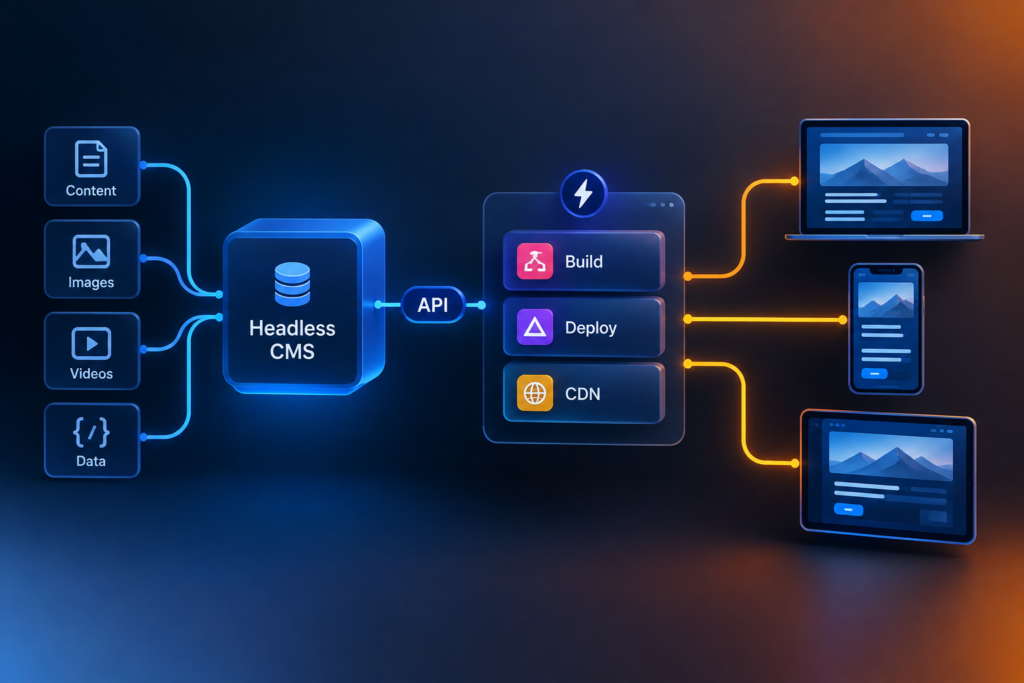
Headless CMS & Jamstack Architecture
In today’s digital landscape, speed, security, and scalability define the success of any website or application. Traditional monolithic CMS platforms like legacy WordPress or Joomla are increasingly falling behind the demands of modern digital experiences.The two paradigm-shifting strategies that are transforming web development are Headless CMS and Jamstack Architecture.
What is a Headless CMS?
In a traditional CMS, the front end (the “head” or presentation layer) and the back end (content management and database) are tightly bound together. A Headless CMS severs this connection by removing the front-end rendering layer entirely.
- Back-End Only: It focuses exclusively on content creation, management, and storage.
- API-Driven: Content is served via lightweight APIs (REST or GraphQL) to any front-end framework.
- Omnichannel Delivery: A single Headless CMS instance can push content simultaneously to a website, iOS/Android apps, smartwatches, or IoT displays.
- Popular Options: Strapi, Sanity, Contentful, Ghost, and Contentstack.
What is Jamstack Architecture?
Jamstack stands for JavaScript, APIs, and Markup. Rather than generating pages on a server at the exact moment a user requests them, Jamstack pre-renders static HTML pages at build time and serves them directly over a Content Delivery Network (CDN).
- JavaScript (J): Handles dynamic functionalities on the client side without relying on backend servers.
- APIs (A): Handles server-side operations, authentication, and database transactions via reusable third-party or serverless APIs.
- Markup (M): Pre-rendered HTML assets generated via Static Site Generators (SSGs) like Next.js, Astro, Gatsby, or Nuxt.
Key Benefits of Combining Headless CMS & Jamstack Architecture
When paired, Headless CMS and Jamstack deliver an unmatched modern web stack:
- Lightning-Fast Performance: Pre-built pages served directly through global CDNs eliminate database queries and dynamic rendering delays, delivering near-instant load times.
- Bank-Grade Security: With no direct database connection or active server exposed on the front end, traditional attack vectors (like SQL injections and cross-site scripting) are virtually eliminated.
- Infinite Scalability: CDN-cached static files easily absorb massive traffic spikes without crashing servers or spiking hosting costs.
- Developer Freedom: Front-end engineers can build using any modern framework (React, Vue, Svelte, Angular) without being locked into a specific templating engine.
- Cost Efficiency: Serving static assets via CDNs drastically reduces server hosting and infrastructure maintenance expenses.
Key Differences Between Traditional CMS and Headless CMS + Jamstack
Traditional platforms like WordPress rely on a monolithic architecture where the front-end presentation and back-end database are tightly coupled. In contrast, the Headless CMS & Jamstack Architecture approach is completely decoupled, keeping content management separate from the display layer.
When it comes to performance, traditional systems often suffer from slowness due to complex database queries, server-side processing, and heavy plugins. Jamstack eliminates these bottlenecks by serving pre-rendered static content instantly via global CDNs.
From a security perspective, legacy platforms are frequently vulnerable to attacks targeting database endpoints, outdated themes, or insecure plugins. Headless Jamstack architecture drastically reduces these security risks because there is no direct database or server exposed to the front end.
Finally, while traditional CMS solutions limit content distribution primarily to standard websites, a Headless CMS allows seamless multi-platform delivery—pushing content concurrently to websites, mobile apps, kiosks, and smart devices through a single backend.
Read the full analysis at jamstack.org or CONTACT